2025
Monday, October 6th, 2025
The Mid-Hudson Bridge
Presented
by Ron Knapp
Titled “The Mid-Hudson Bridge,” this talk by Ron Knapp celebrates the laying of the cornerstone of the bridge on October 9, 1925, a full century ago.
There must have been many who wondered why this cornerstone laying took so long since a contract for its design took place in 1923. The short answer is that the riverbed had to be studied even as structural designs by engineers had to be vetted. How to design and build the road approaches to the span on both the eastern and western sites were hotly debated.
As many of us know who have been crossing the bridge over the past half century, we are aware of ongoing efforts to overcome travel difficulties as traffic has increased.It was not until August 25, 1930 that the 3,000-foot suspension bridge was completed and opened to traffic. Major engineering and environmental challenges slowed its completion for half a decade after the positioning of the cornerstone. Both Franklin andEleanor Roosevelt officiated at the opening during late summer 1930. As a tribute, the bridge was renamed the Franklin D. Roosevelt Mid-Hudson Bridge in 1994.
What brings us together for this talk is the placement of the October 1825 cornerstone. However, this talk will look more broadly as a story of progress over two centuries to link the Hudson’s opposing banks with ferries, a rail bridge, and finally this vehicular bridge.The talk will be illustrated with rare historic images from sources uncovered by Vivian Yess Wadlin.
Ron Knapp, a cultural/historical geographer, is Emeritus Professor at SUNY New Paltz.
While most of his field research and publications over five decades deal with China, he added efforts to understand aspects of the transportation geography of the Northeast United States since 2010. Two of his books, one in 2014 and another in 2023, in part celebrate the first bridge across the Hudson in 1804 between Lansingburg and Waterford, two important towns at the time north of Albany. Until his recent research on The Mid-Hudson Bridge, his focus has always been timber bridges in both China and the US.
There must have been many who wondered why this cornerstone laying took so long since a contract for its design took place in 1923. The short answer is that the riverbed had to be studied even as structural designs by engineers had to be vetted. How to design and build the road approaches to the span on both the eastern and western sites were hotly debated.
As many of us know who have been crossing the bridge over the past half century, we are aware of ongoing efforts to overcome travel difficulties as traffic has increased.It was not until August 25, 1930 that the 3,000-foot suspension bridge was completed and opened to traffic. Major engineering and environmental challenges slowed its completion for half a decade after the positioning of the cornerstone. Both Franklin andEleanor Roosevelt officiated at the opening during late summer 1930. As a tribute, the bridge was renamed the Franklin D. Roosevelt Mid-Hudson Bridge in 1994.
What brings us together for this talk is the placement of the October 1825 cornerstone. However, this talk will look more broadly as a story of progress over two centuries to link the Hudson’s opposing banks with ferries, a rail bridge, and finally this vehicular bridge.The talk will be illustrated with rare historic images from sources uncovered by Vivian Yess Wadlin.
Ron Knapp, a cultural/historical geographer, is Emeritus Professor at SUNY New Paltz.
While most of his field research and publications over five decades deal with China, he added efforts to understand aspects of the transportation geography of the Northeast United States since 2010. Two of his books, one in 2014 and another in 2023, in part celebrate the first bridge across the Hudson in 1804 between Lansingburg and Waterford, two important towns at the time north of Albany. Until his recent research on The Mid-Hudson Bridge, his focus has always been timber bridges in both China and the US.
Monday, August 4th
Historic Highland 1850-1950
Opening Reception Presented
by David Mendelson and Gail Russell
The Town of Lloyd Historical Preservation Society has curated an exhibit of historic images of the hamlet of Highland. The Exhibit, "Historic Highland –1850 to 1950," will be on display beginning August 4th and run through September 26th, 2025, at the Highland Public Library on Elting Avenue, Highland. The exhibit will be open during regular library hours.
Kicking off the event on Monday, August 4th at 7PM, is a discussion of the sites pictured.
The forty-three 11" x 17" framed images are from the collections of Gail Russell, Vivian Yess Wadlin, and the Town of Lloyd Historian's office and include postcards and photographs, each one showing clear detail of the structures and scenes. Some you may recognize, many you will not, but their locations will be familiar. Copies of the images will be available for sale to help raise money for the restoration of the Hendricus Deyo Homestead. Postcards and local publications will also be available for purchase at the opening reception.
Please join us for this informative talk and a chance to mingle with other Lloyd residents and visitors. If you can not make the talk, stop by during regular library hours.
Historic Highland 1850-1950
Opening Reception Presented
by David Mendelson and Gail Russell
The Town of Lloyd Historical Preservation Society has curated an exhibit of historic images of the hamlet of Highland. The Exhibit, "Historic Highland –1850 to 1950," will be on display beginning August 4th and run through September 26th, 2025, at the Highland Public Library on Elting Avenue, Highland. The exhibit will be open during regular library hours.
Kicking off the event on Monday, August 4th at 7PM, is a discussion of the sites pictured.
The forty-three 11" x 17" framed images are from the collections of Gail Russell, Vivian Yess Wadlin, and the Town of Lloyd Historian's office and include postcards and photographs, each one showing clear detail of the structures and scenes. Some you may recognize, many you will not, but their locations will be familiar. Copies of the images will be available for sale to help raise money for the restoration of the Hendricus Deyo Homestead. Postcards and local publications will also be available for purchase at the opening reception.
Please join us for this informative talk and a chance to mingle with other Lloyd residents and visitors. If you can not make the talk, stop by during regular library hours.
Monday, June 2nd
My Name is Eleanor
A Bannerman Island Adventure
presented by Wes and Barbara Gottlick
Eleanor Seeland grew up on little Bannerman’s Island in the Hudson River from 1933-1944 among castles and used military surplus. She was the only surviving person to have lived on the island permanently until her passing in April of 2024 at the age of 92. She handwrote memoirs of her childhood some years ago and made many public appearances with the Gottlocks who wrote a book about her childhood experiences, many of which were adventurous, scary, enchanting or sometimes downright dangerous.
Wes and Barbara Gottlock are retired educators who have co-written eight books about Hudson Valley and New York City history. They have presented over 300 lectures in the metropolitan area covering their books’ topics. Since 2003 they have been active volunteers in various capacities on Bannerman’s Island. The Gottlocks live in New Windsor on a cliff overlooking the majestic Hudson with a birds-eye view of the island.
Monday May 5th
The Chain That Saved The Colonies
presented by Doc Baine
To stop the British invasion of the New England Colonies during the American Revolution, Peter Townsend manufactured a Great Chain at Sterling Forest for the Continental Army. The chain was placed across the Hudson River at West Point. Please join us as Doc Bayne shares with us an eye-opening presentation on how he discovered the forge in Sterling Forest that made the chain.
Doc will share the history of the iron industry that started in 1736 in Sterling Forest and how the Sterling Forge was used to create the Great Chain. Doc has been interested in history since the age of 8 years old. After a long career at Minolta Corporation and working part time as a Forest Ranger at Sterling Forest State Park, Doc accepted the position of Environmental Educator and Historian for the Park. After he retired from the Park, Doc was instrumental in forming the Friends of Sterling Forest. Doc has acquired a vast knowledge of the forest, animals, Native Americans, and iron history. While working for the Park and then with the Friends of Sterling Forest, Doc planned and conducted history and nature hikes. He has lectured on many aspects of the
environment and history of the area. Doc is a passionate researcher and educator with
the ability to feel the history of the land and transmit it to the people.
Doc will share the history of the iron industry that started in 1736 in Sterling Forest and how the Sterling Forge was used to create the Great Chain. Doc has been interested in history since the age of 8 years old. After a long career at Minolta Corporation and working part time as a Forest Ranger at Sterling Forest State Park, Doc accepted the position of Environmental Educator and Historian for the Park. After he retired from the Park, Doc was instrumental in forming the Friends of Sterling Forest. Doc has acquired a vast knowledge of the forest, animals, Native Americans, and iron history. While working for the Park and then with the Friends of Sterling Forest, Doc planned and conducted history and nature hikes. He has lectured on many aspects of the
environment and history of the area. Doc is a passionate researcher and educator with
the ability to feel the history of the land and transmit it to the people.
Monday March 3rd
At Risk: Historic Truss Bridges of the Hudson Valley
The Mid-Hudson Region is blessed with a unique collection of century-old truss bridges. However, their ownership is in question and many have fallen into disrepair. Several bridges are in parks and, if restored and reopened, they could serve as examples of historic preservation as well as provide sorely needed river access.
One bridge in particular, at the Home of Franklin D. Roosevelt National Historic Site, is in danger of
removal. Another bridge along the Hoyt Carriageway in Mills Norrie State Park has long been closed, and Calvert Vaux Preservation Alliance has funding and plans to restore access across it.
Jeffrey Anzevino, Scenic Hudson’s Director of Land Use Advocacy, will describe the collection of century-old truss bridges spanning the Amtrak Line along the Hudson River’s eastern shore in Dutchess and Columbia County and describe the challenges and opportunities related to efforts to restore and reopen these historic truss bridges.
But one needn’t venture to Dutchess County to find an historic truss bridge. We have one—the
“Farmer’s Bridge”--right here in Highland near the Hudson Valley Rail Trail’s Rotary Pavilion. As an
added bonus, Jeff will also provide a brief overview of the Hudson Valley Rail Trail’s initiative to repair and reopen the Farmer’s Bridge.
One bridge in particular, at the Home of Franklin D. Roosevelt National Historic Site, is in danger of
removal. Another bridge along the Hoyt Carriageway in Mills Norrie State Park has long been closed, and Calvert Vaux Preservation Alliance has funding and plans to restore access across it.
Jeffrey Anzevino, Scenic Hudson’s Director of Land Use Advocacy, will describe the collection of century-old truss bridges spanning the Amtrak Line along the Hudson River’s eastern shore in Dutchess and Columbia County and describe the challenges and opportunities related to efforts to restore and reopen these historic truss bridges.
But one needn’t venture to Dutchess County to find an historic truss bridge. We have one—the
“Farmer’s Bridge”--right here in Highland near the Hudson Valley Rail Trail’s Rotary Pavilion. As an
added bonus, Jeff will also provide a brief overview of the Hudson Valley Rail Trail’s initiative to repair and reopen the Farmer’s Bridge.
2024
Monday Sept 9th
Anthony Yelverton-Updating the Legend
presented by Joan de Vries Kelley, Town of Lloyd Historian
Anthony Yelverton-Updating the Legend
presented by Joan de Vries Kelley, Town of Lloyd Historian
Monday June 3rd
History of the Poughkeepsie-Highland Railroad Bridge presented by Fred Schaeffer
Monday May 6th
Crossing the Wallkill:
New Paltz Covered Bridges Then & Now
presented by Ron Knapp
Monday April 8th
Pancake Hollow Primer
presented by Laurence Carr
Pancake Hollow Primer
presented by Laurence Carr
Monday, January 8, 2024
2023
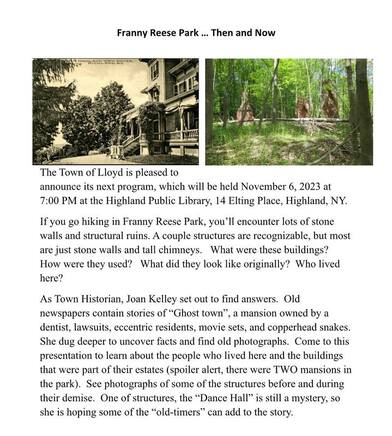
Monday, November 6, 2023
Monday, September 11, 2023
Madams, Mobsters and Murders in the Hudson Valley
Presented by Anthony Musso
Monday, July 10, 2023
Slavery, Segregation & Staatsburgh:
The History & Legacy of Enslavement at Staatsburgh State Historic Site
PRESENTED BY ZACHARY VEITH
Slavery, Segregation & Staatsburgh:
The History & Legacy of Enslavement at Staatsburgh State Historic Site
PRESENTED BY ZACHARY VEITH
Monday, May 1, 2023
WOMEN AND THE D&H CANAL
Presented by BILL MERCHANT
WOMEN AND THE D&H CANAL
Presented by BILL MERCHANT
Monday, March 6, 2023
My Doughboy Grandfather,
Learning a Story Never Told
Presented by Nora Quinlan
My Doughboy Grandfather,
Learning a Story Never Told
Presented by Nora Quinlan
2022
Monday, November 7th
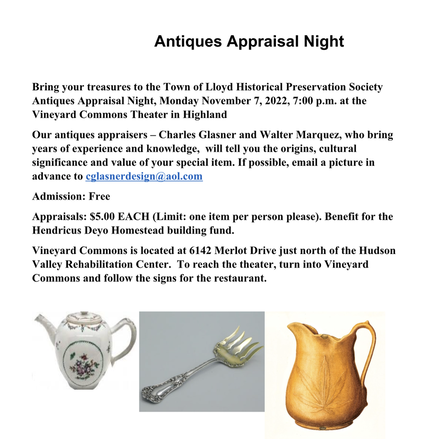
Antiques Appraisal Night
Monday, September 12th
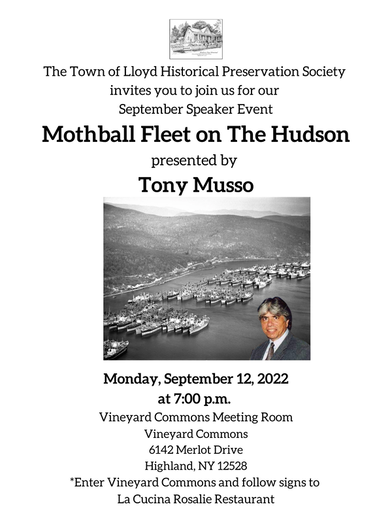
Mothball Fleet on the Hudson
presented by Tony Musso
2020
March 2
Geology and History of Rosendale Cement
presented by Steven Schimmrich
Geology and History of Rosendale Cement
presented by Steven Schimmrich
February 3
“Not The New York Central”
A Unique Look at Local Special Railroads
presented by John Duda
“Not The New York Central”
A Unique Look at Local Special Railroads
presented by John Duda
January 6
I Went to France – and I Survived and Came Home
One Local WWI Soldier’s Story
presented by Richard (Rick) Brooks
I Went to France – and I Survived and Came Home
One Local WWI Soldier’s Story
presented by Richard (Rick) Brooks